Zak Washington’s Guide to England – Lesson 3: The Pub (English Lesson & Cultural Guide)

LEARN real ENGLISH LANGUAGE & CULTURE
World's most comprehensive free non-profit English language and culture course

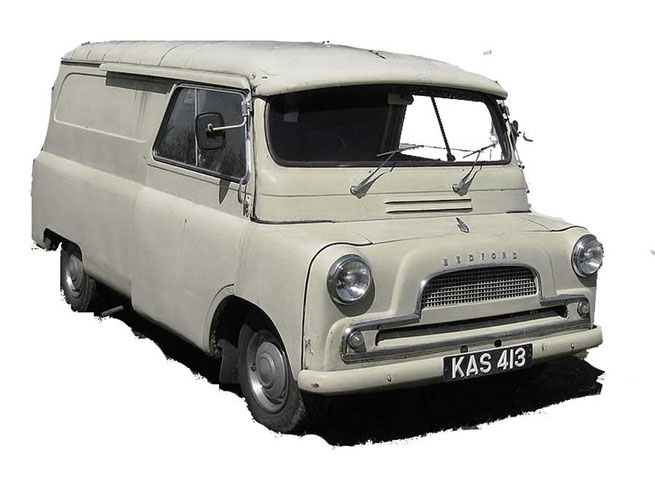
Popular British Bedford van from the early 1970s.

Zak Washington, the corrupt English teacher, is too lazy to work at the language school, so he is taking his group of students to visit a ‘cultural’ place of interest. Today we are going to…..
THE PUB


CLASS ACTIVITY
Brainstorm (SP: lluvia de ideas) vocabulary for pubs.
The student who was the last person to invite everybody for a round of drinks should come to the board to do this.
You can include vocabulary related to drunkenness (SP: embriaguez IT: ubriachezza) , the interior of pubs, the behaviour[1] of people after drinking etc.
[1] Behaviour (noun) (SP: comportamiento IT: comportamento) the way that a person acts.


ENGLISH LANGUAGE VIDEO TUTORIAL
(TEXT VERSION)
ZAK WASHINGTON, THE TEACHER: A very good afternoon to you students! It’s great to have the pleasure of your company once again. It’s seven o’clock in the evening, and it’s time to look at another interesting British cultural institution.
FRANÇOIS: This is starting to get very boring (SP: aburrido IT: noioso). Can’t we go to the Tower of London, Big Ben or London Bridge?
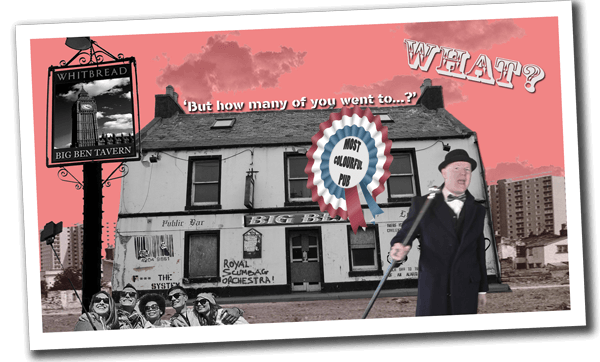
ZAK WASHINGTON: Well today is your lucky day François. We are going to visit Big Ben...... .....Here we are in Baker Street. And there it is! Big Ben. The Big Ben Tavern!
FRANÇOIS: You don’t want to show us any interesting cultural things at all. You just want a drink!
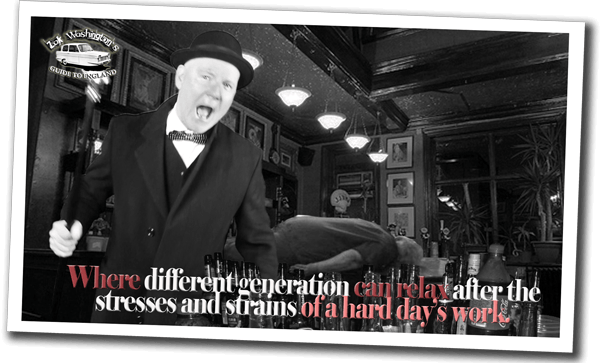
ZAK WASHINGTON: Shut up will you! (SP: cállate IT: stai 'zitta) The pub is one of the fundamental cornerstones (SP: piedras angulares IT: pietre angolari) of any society, where different generations can relax after the stresses and strains[1] of a hard day’s work, and participate in social intercourse and... well... have a drink.
FRANÇOIS: What are you going to teach us? How to order a drink? How to drink it? It’s not difficult. Pick up a beer. Put it to your lips. Voila!
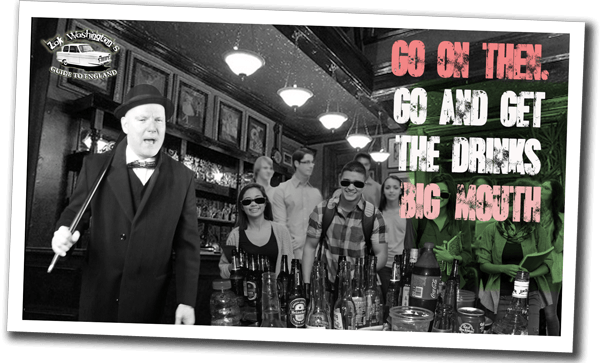
ZAK WASHINGTON: Go and get the drinks then, big mouth! Yes, Sophie? What?
SOPHIE: Teacher, I am a very respectable Catholic girl. I do not like to drink much. I hope that you do not intend to get very drunk.
ZAK WASHINGTON: Errr...no. Of course not Sophie.
FRANÇOIS (speaking to the barman.): Waiter! Give to me one beer!
3.2 François has made several mistakes. What are they? What could he have said to sound more natural?
AUDIO

AUDIO
ZAK WASHINGTON: What terrible English you speak! Take a look at that English gentleman over there. Listen to the way he orders a drink correctly.
ANJA: That’s not a gentleman. He has a skinhead with tattoos, earrings (SP: aretes IT: orecchini) , a football shirt and a bulldog. Hey! It’s a real hooligan? (Students run over to take selfies with a ‘real’ hooligan.
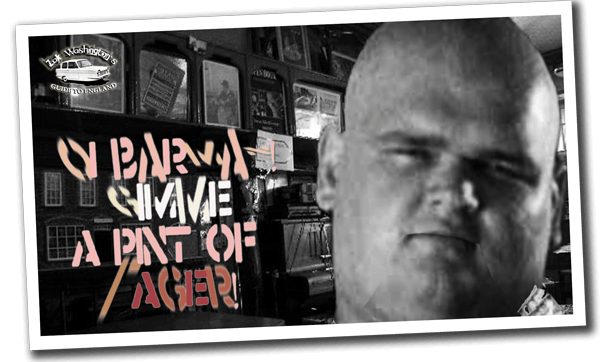
HOOLIGAN: Oi! Barman, gimme a pint of lager[2]! Hello there, Zak Washington! How’s it going mate (SP: colega IT: compagno) ?
ZAK WASHINGTON: Errr.. Hello Dave.
MARIA: I don’t believe it! Do you know that horrible man?
(Ding, ding, ding. A bell sounds behind the bar.)
SOPHIE: Oh, no I think that there’s a fire!
ZAK WASHINGTON: No, Sophie. That’s the last orders bell. It’s not a fire. But it’s definitely an emergency. So quick, let’s get some drinks before the pub closes.
GLOSSARY
[1] Stresses and strains (nouns) (SP: tensiones IT: tensioni)
troubles, difficulties, problems, anxieties, etc.
[2] Lager (noun) the most typical type of beer in Britain and Europe. Golden in colour. Recommended.
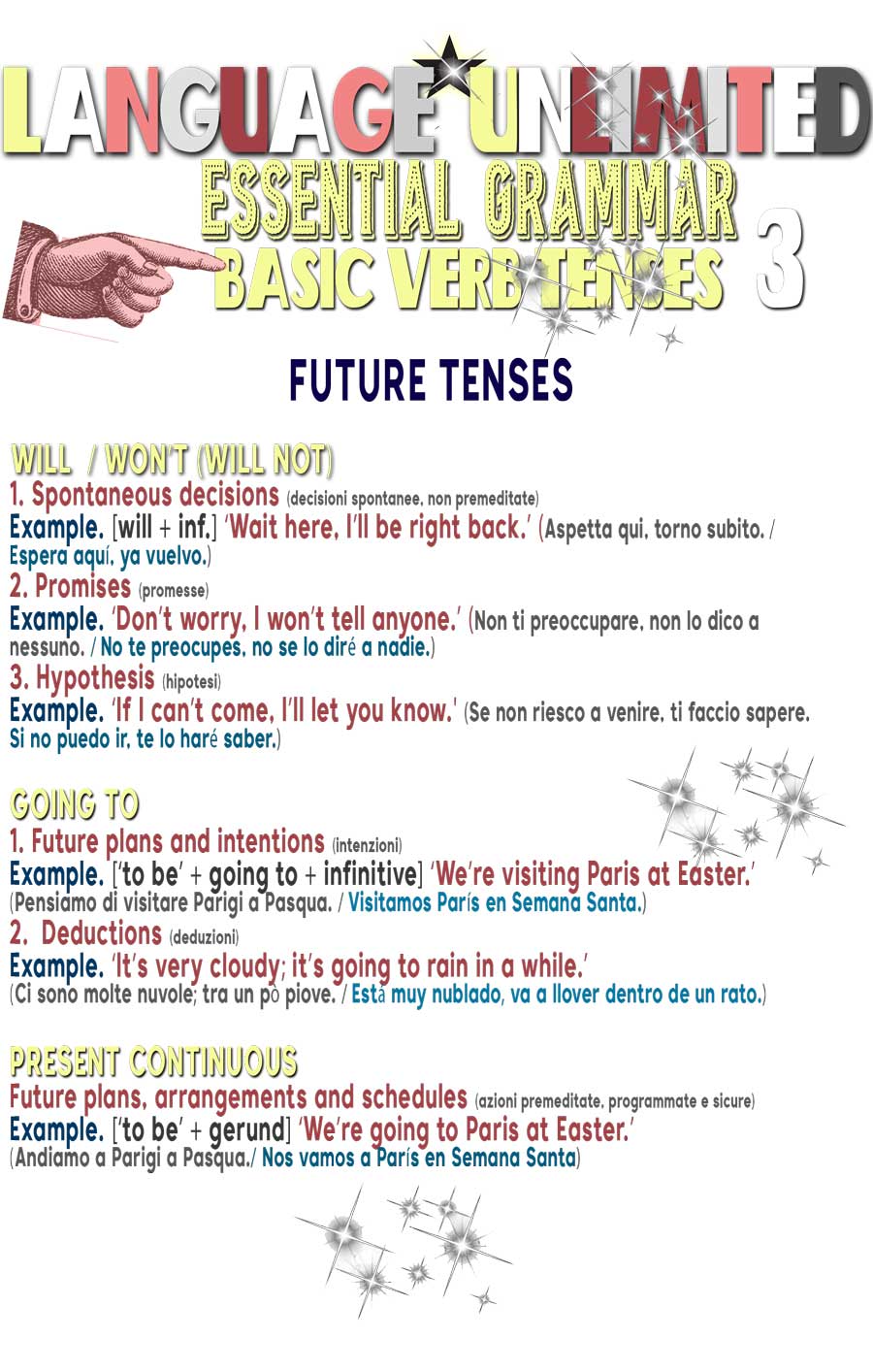
ESSENTIAL ENGLISH GRAMMAR - FUTURE TENSES
ENGLISH LEARNERS' MAGAZINE (Downloadable)


Social English Vocabulary Video Tutorial
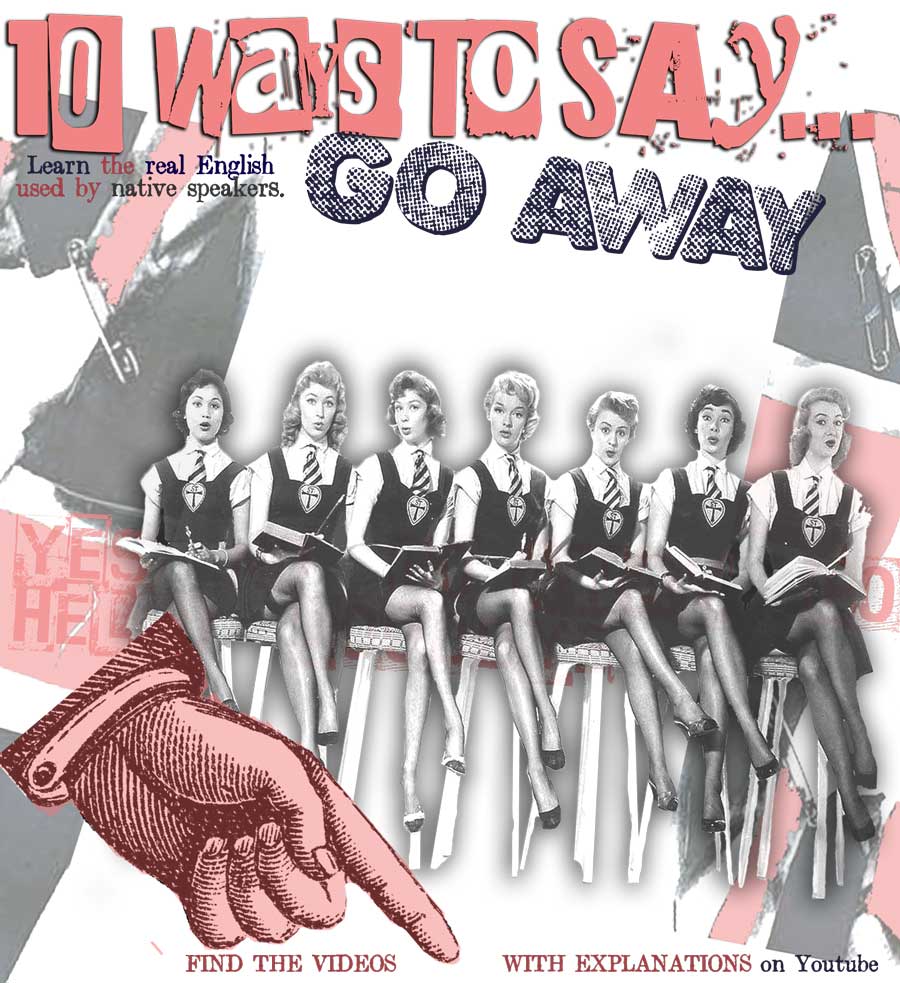
12 WAYS TO SAY 'GO AWAY' - AUDIO
(TEXT VERSION)
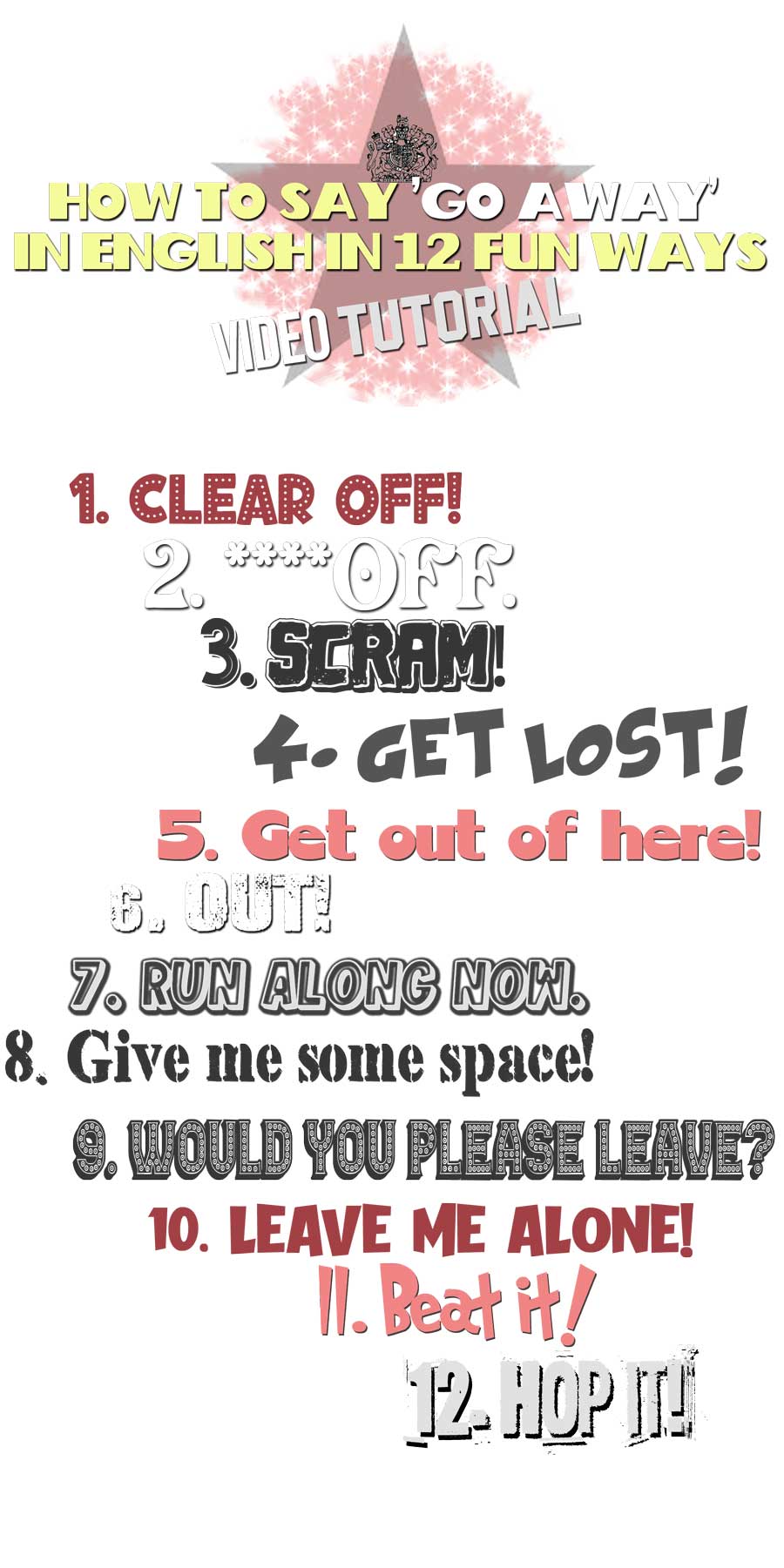
1. Clear off!
2. **** off!
3. Scram!
4. Get lost!
5. Get out of here!
6. Out!
7. Run along now!
8. Give me some space!
9. Would you please leave!
10. Leave me alone!
11. Beat it!
12. Hop it!

ESSENTIAL 'BAD' ENGLISH
BRITISH SLANG - AUDIO
(TEXT VERSION)
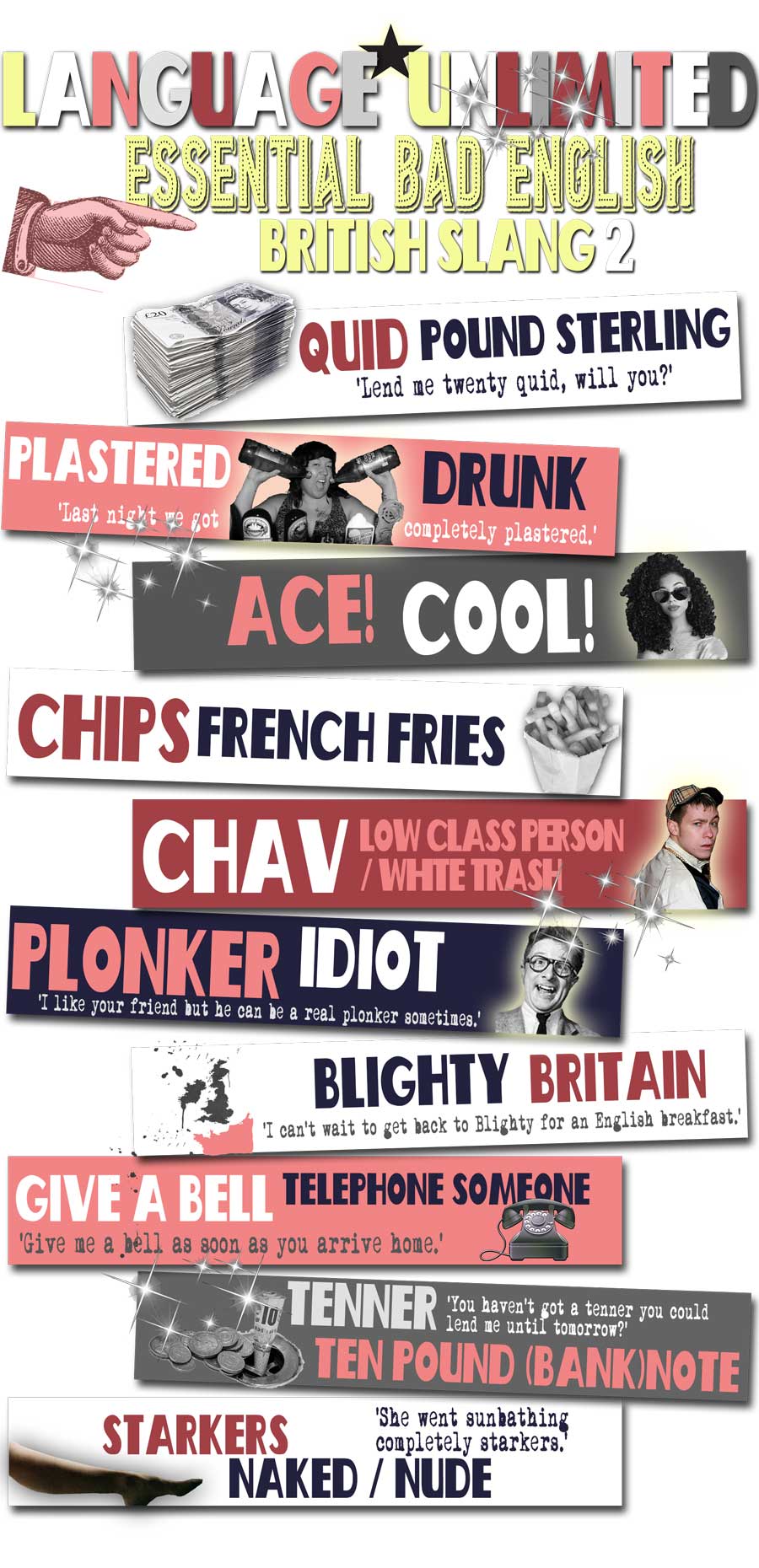
ESSENTIAL BAD ENGLISH
BRITISH SLANG 2
QUID
POUND STERLING
'I send me twenty quid, will you?'
PLASTERED
DRUNK
'Last night we got completely plastered.'
ACE
COOL
'The football match was ace!'
CHIPS
FRENCH FRIES
'Give me a portion of chips with salt and vinegar.'
CHAV
LOW CLASS PERSON / WHITE TRASH
'This town has been invaded by idiotic chavs.'
PLONKER
IDIOT
'I like your friend but he can be a real plonker sometimes.'
BLIGHTY
BRITAIN
'I can't wait to get back to Blighty for an English breakfast.'
GIVE A BELL
TELEPHONE SOMEONE
'Give me a bell as soon as you arrive home.'
TENNER
TEN POUND (BANKNOTE)
'You haven't got a tenner you could lend me until tomorrow?'
STARKERS
NAKED / NUDE
'She went sunbathing completely starkers!'
3.3 Discussion Topics.
Have you ever been to a typical British or Irish pub?
What was it like? Describe the interior. Describe your experience.
Do you remember any of the names of the pubs that you visited?
What is the difference between a pub and a bar?
How do bars in your country differ from those in Britain?
Do people go to pubs only to drink?
Is it possible to eat meals there?
Tell us about the types of food available (SP: disponible IT: disponibile) in pubs in your country.
What time do bars in your country open and close?
Do you think these times differ from British opening times?
What type of people go to the pub?
Are pubs in your countries for the whole family or just for adults?
Are country pubs different from city pubs?
Do different classes of people have different types of pubs?

Essential British Pub Vocabulary


ASPECTS OF ENGLISH CULTURE: THE PUB
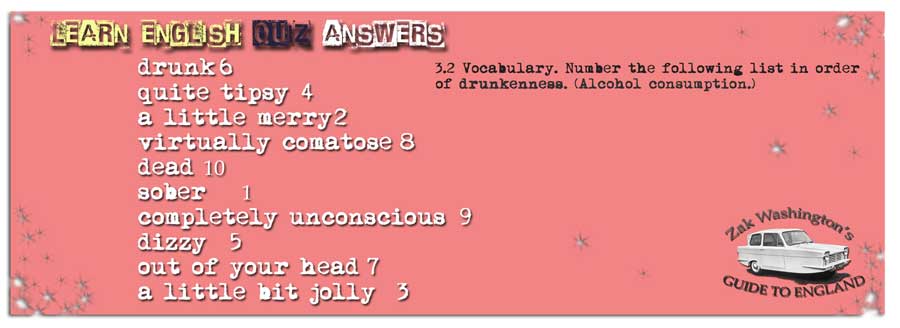
PUB VOCABULARY QUIZ. Extract from ZAKMAG, our complimentary easy English learning magazine.
British Culture - Pub Vocabulary Quiz
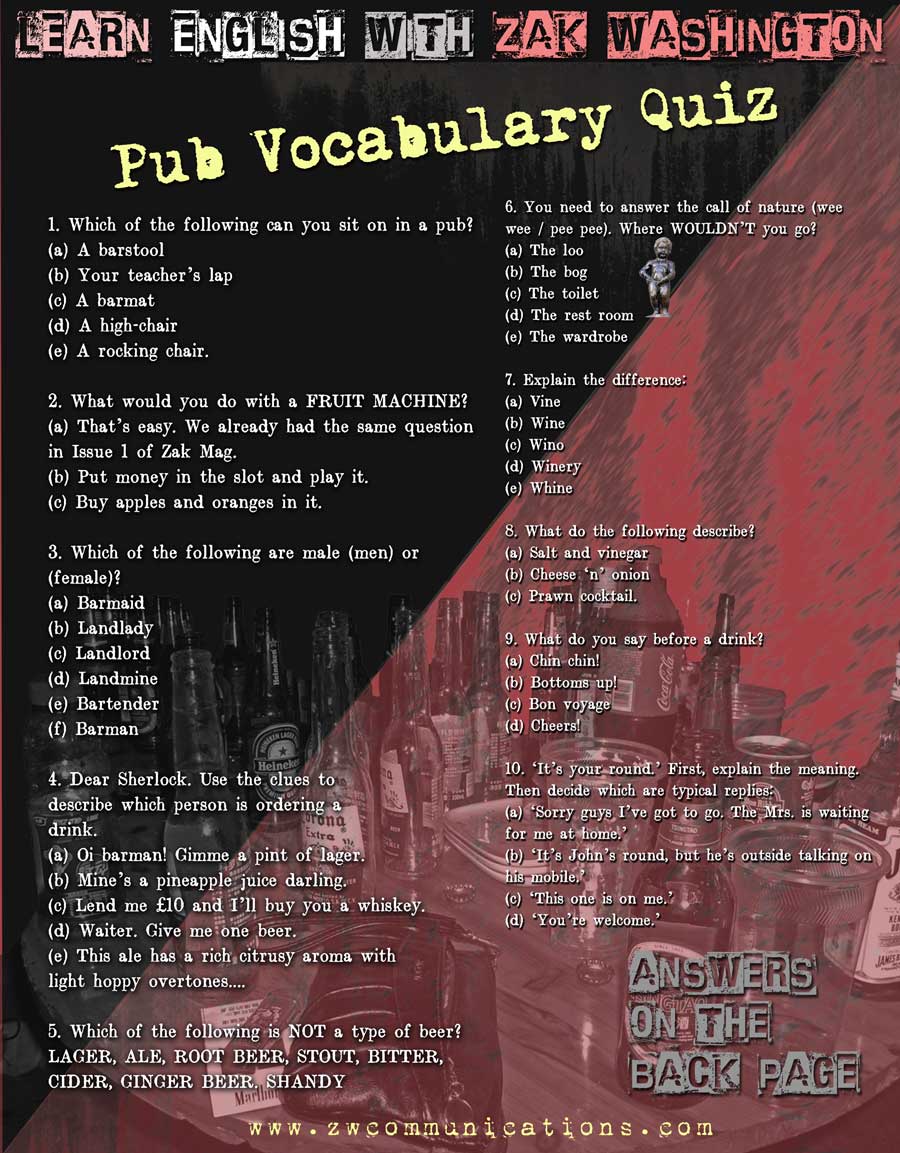
The answers are down below at the bottom of the page - Scroll down!

ENGLISH CULTURE: FEMINISM
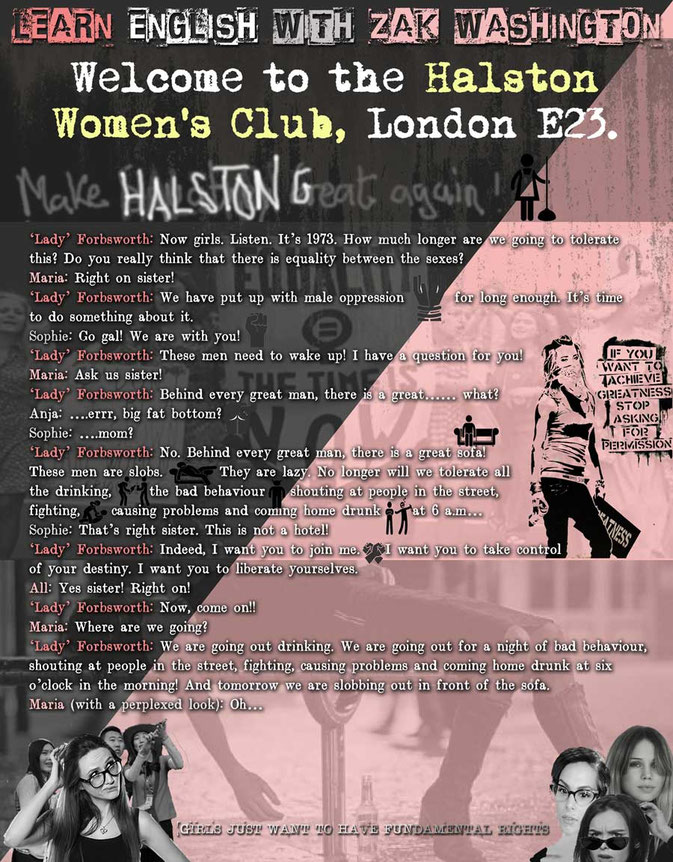
The Halston Feminist Club discuss women, rights and alcohol
Extract from ZAKMAG, our complementary easy English learning magazine.
AUDIO
(TEXT VERSION)
(At the Squatney Women’s Club, London.)
‘Lady’ Forbsworth: Now girls. Listen. It’s 1973. How much longer are we going to tolerate this? Do you really think that there is equality between the sexes?
Maria: Right on sister!
‘Lady’ Forbsworth: We have put up with male oppression for long enough. It’s time to do something about it.
Sophie: Go gal! We are with you!
‘Lady’ Forbsworth: These men need to wake up! I have a question for you!
Maria: Ask us sister!
‘Lady’ Forbsworth: Behind every great man, there is a great…… what?
Anja: ….errr, woman?
Sophie: ….mom?
‘Lady’ Forbsworth: No. Behind every great man, there is a great sofa! These men are slobs. They are lazy. No longer will we tolerate all the drinking, the bad behaviour, shouting at people in the street, fighting, causing problems and coming home drunk at six o’clock in the morning…
Sophie: That’s right sister. This is not a hotel!
‘Lady’ Forbsworth: Indeed, I want you to rise up. I want you to take control of your destiny. I want you to liberate yourselves.
All: Yes sister! Right on!
‘Lady’ Forbsworth: Now, come on!!
Maria: Where are we going?
‘Lady’ Forbsworth: We are going out drinking. We are going out for a night of bad behaviour, shouting at people in the street, fighting, causing problems and coming home drunk at six o’clock in the morning! And tomorrow we are slobbing out in front of the sofa.
Maria (with a perplexed look): Oh…
ESSENTIAL ENGLISH - IDIOMS
AUDIO

ENGLISH GRAMMAR - MODAL VERBS


What are the modal verbs for certainty? (Positive and negative.)
What are the modal verbs for possibility? (Three possibilities.)

(Three hours later, everybody is completely drunk. Giovanni is kissing what he thinks is a beautiful English woman, but who, in reality, is a male pickpocket [1]. Maria is homesick (SP: nostálgico IT: nostaligo) and crying. Sophie is half naked (SP: semi-desnuda IT: mezza nuda) on the bar, and has French kissed [2] half the pub.)
ZAK WASHINGTON: Hey! Where is François? I haven’t seen him for at least twenty minutes.
AHMET: When did you see him last?
[1] to pickpocket (SP: robar - carterista IT: rubare - borseggiatore) to steal from a person (wallet, money, etc normally without violence).
[2] to French kiss is like ‘a kiss’ but usually much longer, wetter and more passionate.... with tongues!
Other interesting ways of describing the same action are to snog, a kind of teenage word, and the American phrasal verb to make out.
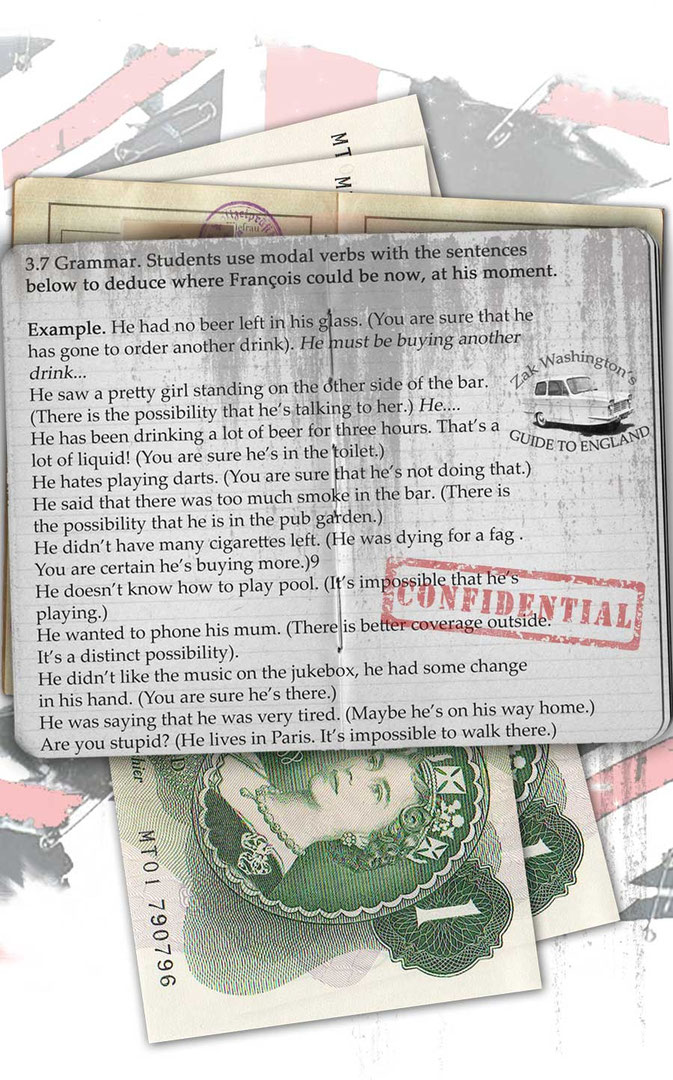

ZAK WASHINGTON: This is very mysterious. Let’s think about what he was doing in the last moments before his disappearance (SP: desaparición IT: scomparsa).
GIOVANNI: (now smoking a Sherlock Holmes pipe.) He seemed very interested in a blond girl who was at the other side of the bar.
SOPHIE: (now wearing a Sherlock Holmes hat.) He had gone to the bar, was drunk and talking to various people about how he didn’t like England.
MARIA: (now with a Doctor Watson moustache (SP: bigote IT: baffi) .) That hooligan was looking at him in a strange way.
ANJA: I think I saw him going to the toilet. I’m going to look for him.
(Later)
ANJA: Oh, my God! I’ve found François, he was lying on the restroom (SP: cuarto de baño IT: WC) floor completely wet with blood on his face! Here he comes now!
BRITISH CULTURE DISCUSSION PUBS AND DRINKING


READING EXERCISE
AUDIO

(Text version)
(Zak and Ahmet are in the pub again having a typical sexist conversation about women.)
ZAK WASHINGTON: Hello mate.
AHMET: Alright mate.
ZAK: How are you getting on with that Swedish girl?
AHMET: Really well. She loves me. She has been talking to me for two hours.
ZAK: She’s not interested in you.
AHMET: What are you talking about? She hasn’t taken her eyes off me all night. She can’t get enough of me.
ZAK: She can’t get enough of your English.
AHMET: What?
ZAK: She just wants to practice English with you.
AHMET: You are joking!
ZAK: Plus, you are buying all the drinks for her.
AHMET: You are kidding!
(One month later in the same pub.)
ZAK WASHINGTON: Hello mate.
AHMET: Alright mate.
ZAK: How are you getting on with that Swedish girl?
AHMET: Really well. She loves me. She has been talking to me for two hours. She hasn’t taken her eyes off me all night. She can’t get enough of me.
SWEDISH GIRL: Hi! How’s my favourite English teacher. Can I buy you another drink? Come over here with the other girls and we can chat some more.
What are the past forms of must, may, might, could and can’t?
Students now speculate about what has happened to François, but this time using modal verbs in the past.

FRANÇOIS: (arriving back from the loo[1].) I have had a terrible experience....
I went to chat up[2] a pretty girl at the bar.
It turns out[3] that she was the hooligan’s girlfriend...
...he followed me to the bathroom...
...he beat me up....
...then he put my head in the toilet and pulled the flush...
...he made me drink the water from the toilet bowl to teach me a lesson...
and then he mugged[4] me.
You English people are horrible! Why do you do this? You drink so much and then you...
3.10. Explain exactly what has happened to him.
ZAK WASHINGTON: Hey! Wait a minute. It’s not my fault!
GLOSSARY & USAGE - How to ask for the bathroom in English!
AUDIO
[1] Loo (noun) (colloq.) (SP: cuarto de baño IT: WC) You are in a British pub and you need to answer the call of nature!
What do you ask for? Which door do you go into?
Asking for the loo is a friendly and fairly polite British way of saying toilet, a word that natives often prefer not to use.
Loo is probably the safest word to use in most situations in Britain, either in public places or private homes.
Both words also refer to the receptacle that you find in the bathroom.
This is a problematic area in English, as there are so many words that can refer, in different ways, to the same thing.
You might sound a little strange asking for the bathroom in a pub, as there is no bath, but it is perfectly acceptable in someone’s house.
The word W.C. is very old fashioned and not used (except in Spain!).
Similarly little boy’s room and women’s powder room, which sound Victorian.
Restroom is polite, socially acceptable, but will make you sound like an American tourist.
The john and the can are also American, but are very colloquial.
The dunny is a comical Australian way of expressing the same idea, the bog and the crapper are very crude slang words in Britain, not to be used in good company.
Other things that you might find on the doors of public toilets in bars are the letters G and L.
Which one would you enter?
G means Gentlemen (sometimes written as Gents), and Ladies.
You might also find his and hers, guys and gals, or even as John and Jane.
[2] To chat up (SP: ligar IT: rimorchiare) to talk to somebody with romantic intentions. If you are successful, you can say that you have picked up.
[3] To turn out (SP: resultar IT: rivelarsi) to have the result of.
[4] To mug (SP: asaltar IT: assalire) to rob a person violently (usually in the street).
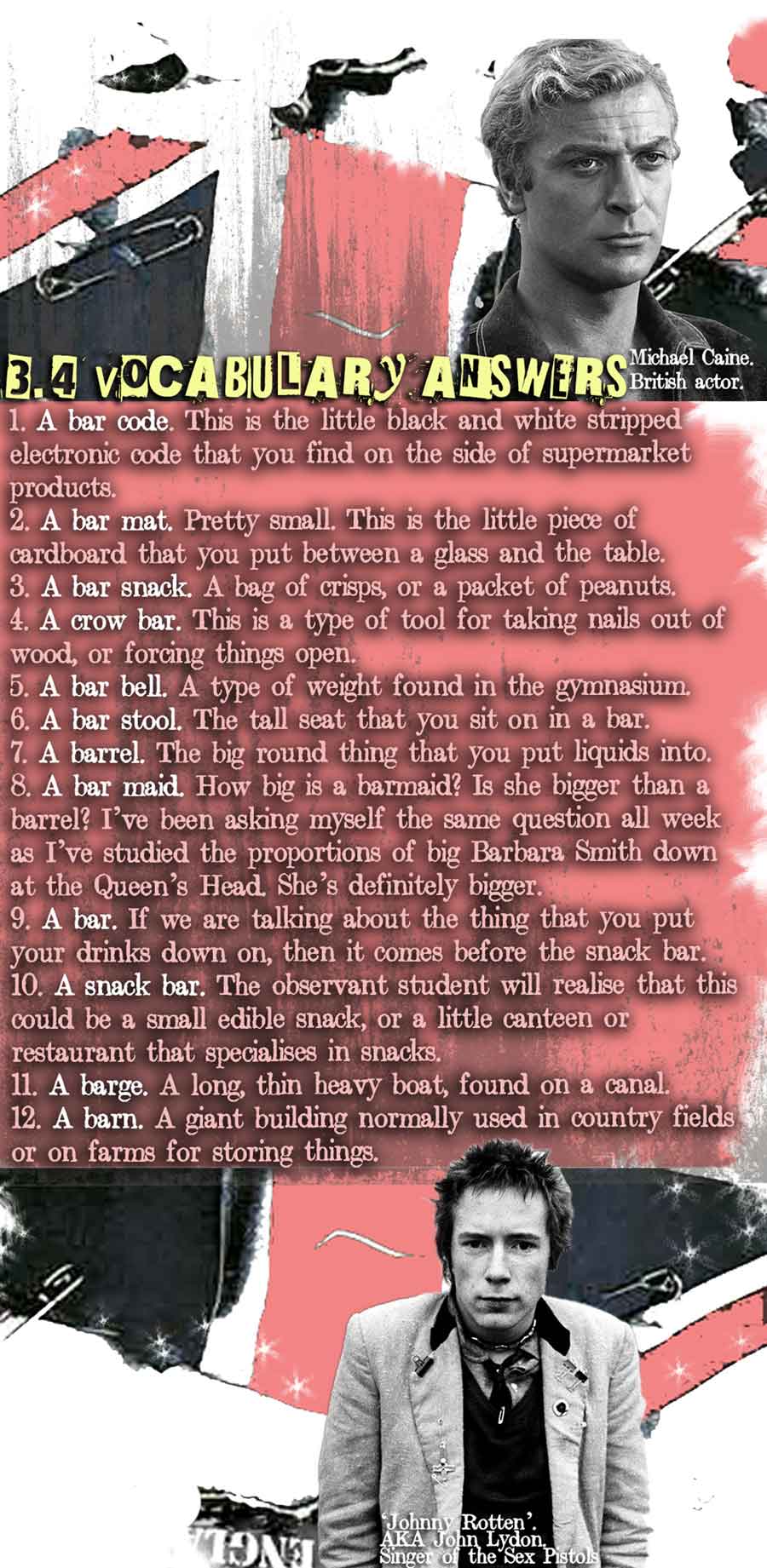
ASPECTS OF ENGLISH CULTURE BAR VOCABULARY (Key to questions above)
English Language Grammar Section
What are the modal verbs for advice (SP: consejos IT: consigli, raccomandazione) ? (Positive and negative.)
What are their past forms? Everybody should give advice to François.
What should/shouldn’t he do now?
Take it in turns to be François. Use the following prompts (SP: indicaciones IT: suggerimenti).
I have wet hair. You ought to......
I have blood on my lips (SP: labios IT: labbri).
I feel terrible. I’ve drunk too much.
They have taken all my money.
I hate Great Britain.
How am I going to get back? My ticket was in my wallet (SP: cartera IT: portafoglio).
What will I tell my family?
My head aches. (SP: duele IT: fa male My stomach is turning over.
I think I am going to be sick. (SP: vomitar IT: vomitare)
I’m never going to drink again.
What about informing the authorities?
All I wanted was to come to London, see a few sights (SP: monumentos IT: attrazioni, monumenti) and learn a bit of English.

What should/shouldn’t he have done before the beating?
(SP: debería haber hecho... IT: avrebbe dovuto fare...)
Continue as above but now use the past forms to give advice.
I was stupid enough to listen to Zak Washington.
It would have been better to visit the Tower of London.
I don’t drink regularly. I got drunk very quickly.
I drank far too much.
I only wanted to chat up a pretty English girl.
How did I know that she was Dave the Hooligan’s girlfriend?
I took my wallet out. Everybody saw that I had a lot of money.
I went to the restroom alone.
Dave the Hooligan said he wouldn’t hurt me if I apologised[1] to him.
I wish I had stayed at home in my own country.
[1] to apologise (SP: disculparse IT: scusarsi) to say sorry.


3.14 English language learners grammar activity: Used to + gerund / infinitive
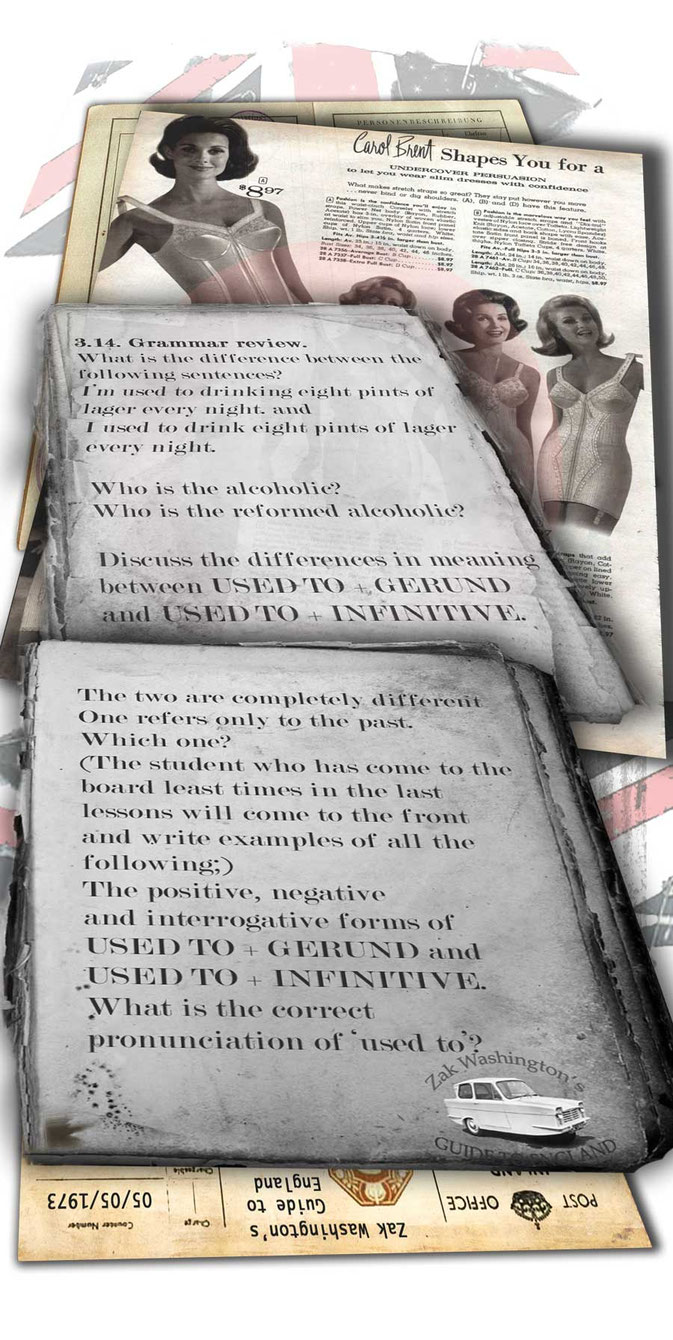


Think about your country and discuss the following using only USED TO + INFINITIVE. (SP: solía... IT: tempo imperfetto) Clothes, hair, music, entertainment and lifestyle in the 1960s. Now do the same for the following decades. 1970s, 1980s, 1990s. What were the differences between your country, the United States and Britain during these decades?


Now let’s use the two structures
USED TO + GERUND
(SP: acostumbrado a... IT: abituato a)
USED TO + INFINITIVE
(SP: solía... IT: tempo imperfetto)
It is absolutely essential to not get the gerund and infinitive mixed up (SP: mezclados, confundidos IT: mischiato) , as the meaning (SP: sentido, significado IT: senso, significato) changes completely.
You will be given different situations. You must get together with a partner and ask and answer about each situation.
Example: You’ve just left home for the first time.
What did you use to do?
I used to come home before midnight.
(SP: solía regresar... IT: venivo a casa...)
What didn’t you use to do?
I didn’t use to come home at six o’clock in the morning.
(SP: no solía regresar... IT: no venivo a casa...)
What are you getting used to doing?
I’m getting used to cooking my own food.
(SP: me estoy acostumbrando a... IT: mi sto abituando a...)
Now do the same for the following situations.
You’ve moved to a dirty flat in London with awful English students.
What did you use to do? What didn’t you use to do? What are you getting used to doing?
You’ve given up your job at the old people’s home (SP: casa de ancianos IT: casa per anziani) .
You’re unemployed (SP: parado IT: disoccupato).
You’ve given up smoking marijuana.
You’ve succeeded in stopping gambling.
You’ve got married to a strict feminist (men)/an awful male chauvinist (SP: machista IT: maschilista) (women).
You’ve become one of those old, miserable pensioners that you’ve always hated.
You’ve become the millionaire author of a truly original book.
You’ve got married to the prince/princess.
You’ve got divorced from him/her.
Now close your book and repeat the process in pairs with your own examples. Be very careful with the gerund and infinitive.


Read Aloud Pronunciation Practice
AUDIO

ENGLISH SPEAKING PRACTICE PRONUNCIATION READING (AUDIO ABOVE)
Anja’s guide to speaking perfect English. PART ONE.
Pronunciation reading exercise.
As you should know, Anja is a gorgeous, intelligent, beautiful Dutch student.
What you probably didn’t know is that she speaks far better English than your teacher, who is an ignorant, badly-educated country yokel.
Anja is going to explain about why English pronunciation is so complicated, and how you can improve.
Read the following text paying particular attention to the pronunciation.
Why is pronunciation so complicated?
Why are there so many words with different sounds, which are written in completely different ways?
Why can’t we just pronounce the words the way that they are written?
What is the difference between ‘were’ ‘where’ and ‘wear’?
What is the difference between ‘bored’ and ‘board’?
How many syllables do ‘chocolate’ and ‘vegetable’ have?
Why am I asking so many questions?
The people to blame are the Italians, the Scandinavians, the French, the Greeks, and many others.
The ancient Romans came to Britain, and tried to use their five vowels to write down a language with many other sounds.
Why didn’t they just make up some new letters?
The Vikings, the Celts, among others strongly influenced the development of what we call ‘modern English’.
The French though, have had the biggest influence of all on English.
When they invaded the island in 1066 A.D, French became the most important language in Britain for the next few hundred years.
To the present day French has an enormous influence on English pronunciation.
Look at some of the words of French origin that we have in English.
The word ‘mayor’ (the head of local government) sounds French. ‘Massage’, ‘barrage’, and ‘garage’ (British English) have a distinctively French flavoured suffix.
Compare these to the endings of ‘passage’, ‘marriage’, ‘carriage’, and ‘cabbage’.
In fact, many words come directly from French with virtually no change in spelling or pronunciation. ‘Bon appetit’, ‘liaison’, ‘petite’, ‘en route’, ‘en suite’, ‘hors-d’œuvre’, ‘coup’, ‘boutique’, ‘chauvinism’, are just a few of hundreds (thousands?) of words in common use.
But do be careful, as we often change the meanings.
So what is the best advice for mastering English pronunciation?
Probably, that you should study the difficult vowel sounds. English has twelve vowel sounds represented by only five letters.
Plus, there are diphthongs too.
Which is the most common vowel sound? The answer is the ‘schwa’.
This is the smallest possible sound in English, and doesn’t exist in many other languages.
It is sound of the ‘ER’ at the end of words such as ‘computer’, ‘father’, ‘mother’, and is also found at the beginning of many words too. ‘Enough’, ‘alarm’, and ‘aloud’, all have the schwa at the beginning.
What usually confuses students is that sometimes, different vowel sounds are used to represent the same letter, in the same word.
Study the word ‘federation’; the two ‘E’s are completely different in sound; this is a common characteristic of multi-syllable words.
Also consider ‘to separate’, ‘manager’, and ‘promotion’, which also have different sounds for the same letters.
Another distinctive characteristic of English is its contraction of vowel sounds.
The correct pronunciation of the following words ‘were’, ‘to’, ‘and’, ‘a’, ‘for’ and ‘can’ differ depending on their importance in the sentence.
But all of these words (and many more too) can have a shorter, more contracted pronunciation.
Listen to the following phrases: ‘The family were poor’; ‘It’s five to eight’; ‘Fish and chips’; ‘What a night!’; ‘Vote for Smith’; ‘I can swim for 15 metres’.
None of the underlined words are important, so the sound is contracted and replaced with the schwa.
What other problematic vowel sounds are worth looking at?
We should consider the five long sounds that characterise British English (or more accurately what is known as ‘received pronunciation’ -the accent that typifies South-eastern English, or is used by BBC newsreaders).
One of these is the difficult sound that appears in all the following words: ‘or’, ‘more’, ‘door’.
Not so difficult, eh? You know those already. But did you realise that the same sound is contained in the following?: ‘Law’, ‘court’, ‘caught’, ‘brought’, ‘fought’, ‘saw’, ‘wore’, and even ‘talk’.
Another English sound that causes problems is the one contained in ‘cheap’, ‘beat’, ‘seat’, ‘sheep’ and ‘leap’.
These are long sounds. If you shorten them too much, you will end up saying: ‘chip’, ‘bit’, ‘sit’, ‘ship’ and ‘lip’.
The difference between these sounds is the difference between literally hundreds of words in English. (Including swearwords: ‘sheet’, and ‘piece/peace’ if not pronounced correctly will cause you much embarrassment).
There are two important factors to take into consideration: first, is the shape of your face.
Smile! For the words cheap’, ‘beat’, ‘seat’, ‘sheep’ and ‘leap’, you need to pull the sides of your mouth out as if you were smiling.
Now say the same word again, this time with a more normal, ‘serious’ face, and you should be saying: chip’, ‘bit’, ‘sit’, ‘ship’ and ‘lip’.
Watch and listen to your teacher, and remember, that if you are not moving your jaw, you are not pronouncing the words correctly.
The other important factor is the length of the sound.
Let’s take a look at one more elongated vowel sound.
This is the sound that appears in the following words: ‘heart’, ‘start’, ‘large’, ‘art’ and ‘bath’. To get an idea of how this should sound, go to the dentist.
He will sit you in the dentist chair and tell you to say ‘arrrggghhh’. So get your mouth open.
Let’s see those lovely teeth. On second thought, close your mouths; I don’t want to see the remains of your breakfast.