Zak Washington’s Guide to England – Lesson 14: Speaker's Corner (English Lesson & Cultural Guide)
LEARN real ENGLISH LANGUAGE & CULTURE

World's biggest free non-profit English language and culture course

In this LESSON 14 you will learn how to make public speeches and presentations in English.
We will explain how to structure talks.
After we will explain how to speak better English in public.
We will teach you English grammar for future tenses.
In the final part of the lesson there is English for arms and weapons, crime and punishment vocabulary.
Finally students will practice with communication activities, quizzes and games.
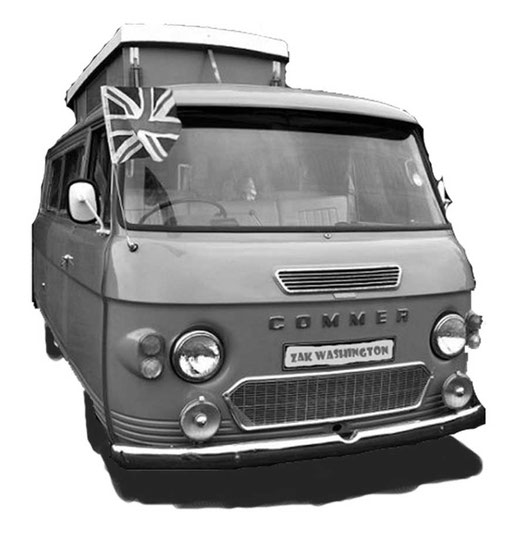
British Culture: Vintage Commer camper van

Zak Washington, the corrupt English teacher, is too lazy to work at the language school, so he is taking his group of students to visit a ‘cultural’ place of interest. Today we are going to…..
SPEAKER’S CORNER

ZAK WASHINGTON: A very good afternoon to you students! We are here stood in another typical area trying to decide what to do. The situation is desperate. What on earth are we going to do?
AJMET: I can see police helicopters circling the city. The army are looking for us. The press are chasing us!
MARIA: (crying) I’m very, very frightened.
ZAK WASHINGTON: Anja what in your opinion is the best option?
ANJA: We have managed to attract quite a bit of attention here. Ali’s flight leaves in two hours time. We need to find somewhere to go, that is on the way to the airport, where we won’t be recognised.
SOPHIE: Let’s go to the Tower of London!
ZAK WASHINGTON: Are you insane? They will lock us up!
CHRIS OFF: We could head for Madame Tussaud’s,
pop in there for half and hour, or
chill out in one of the parks.
Or we could put off doing that until later.
I’m for taking advantage of this sun.
If we hurry up, we could check out Speaker’s Corner in Hyde Park.
That place is always full up with tourists.
No one will find out who we are.
We will blend in easily with all the other foreigners. 14.1. Explain Chris’ phrasal verbs.
ZAK WASHINGTON: Great idea! We’ve got nothing else to do!
CHRIS OFF: Come on then!


Match the following words with the correct definition.
1. A speech
2. An orator
3. A heckler
4. A remark
5. A retort
6. To barrack
7. To discuss
8. To argue
9. To talk down to sb
10. To answer back
11. A put down
12. A pun
a. A synonym of ‘comment’.
b. Talk between people that is aggressive by nature.
c. A comment made with the intention of making the other person seem stupid.
d. An organised talk to inform the listener about a subject.
e. An ingenious use of a word that has a double meaning.
f. A way of replying to someone, that shows a lack of respect for the speaker. The way an impertinent child speaks to his/her parents, for example.
g. A person who shouts out comments (usually funny) with the intention of distracting a public speaker.
h. A person who gives talks in public.
i. A very aggressive and negative way of trying to intimidate and distract a public speaker.
j. To debate in a civilised way.
k. To speak arrogantly to someone, as if that person is inferior.
l. A clever, witty or intelligent comment, that is usually said quickly as a reply to someone else.

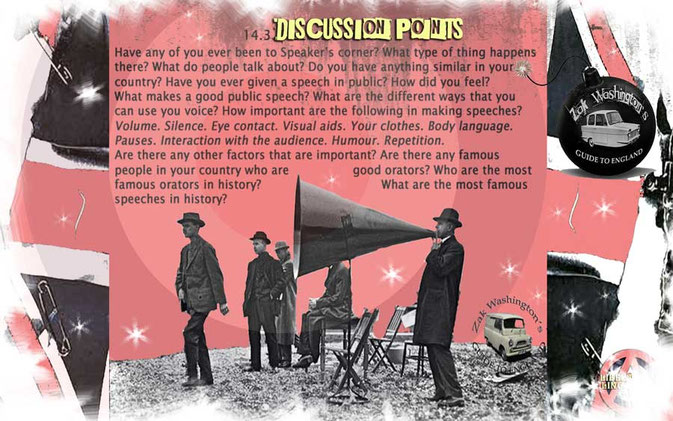
(TEXT VERSION)
14.3. Discussion Points.
Have any of you ever been to Speaker’s corner?
What type of thing happens there?
What do people talk about?
Do you have anything similar in your country?
Have you ever given a speech in public?
How did you feel? What makes a good public speech?
What are the different ways that you can use you voice?
How important are the following in making speeches?
Volume. Silence. Eye contact. Visual aids. Your clothes. Body language. Pauses. Interaction with the audience. Humour. Repetition.
Are there any other factors that are important?
Are there any famous people in your country who are good orators?
Who are the most famous orators in history?
What are the most famous speeches in history?

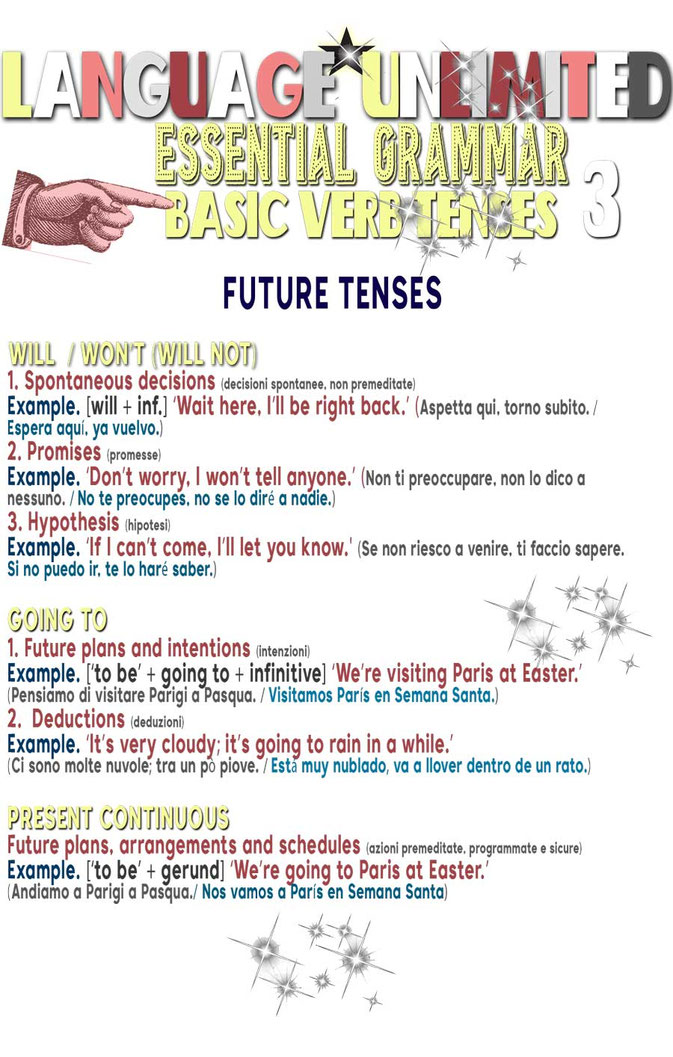
14.4 ENGLISH GRAMMAR FUTURE TENSES

Today’s lesson is about public speaking, therefore one of you must come to the board in order to speak and write about the grammar for future tenses. You teacher has had a long and difficult day, and would like to rest a little. The student with the untidiest handwriting will do this. You need as much practice as you can get! The other students will debate the following points between themselves and then give instructions as to what will be written on the board.
What are the future tenses in English? How many different ways of expressing the future can you think of? Think about the following; Timetabled events, spontaneous decisions, planned actions, arrangements like those that you would put in your diary, predictions, etc. Give examples of the future simple, the future continuous, the future perfect, the future perfect continuous. What is the difference between ‘will’ and ‘shall’? What are all the negative and interrogative forms of these future tenses?



Look at the following dialogues and write the correct future tenses. Be careful! Some of the examples may not require a future tense.
ALI: I feel so terrible! What’s the matter with me? (Hic!) When ______[BLANK] this pain in my head ______[BLANK] (to end)?
AJMET: We ______[BLANK] (to send) you back to your own country, because you have a problem with one of the worst cases of jet lag known to man. When you get back home you ______[BLANK] (to feel) much better. There, your own doctors ______[BLANK] (to be able to) look you over, and find out why there has been such a problem. ______[BLANK] I get you another refreshment?
ALI: Yes. You are a true gentleman. Have a fifty pound tip! (Hic!) It ______[BLANK] (to make) me feel much better. I don’t know what ingredients you people put in your traditional refreshments, but they always make me feel great. What time ______[BLANK] my plane ______[BLANK] (to leave)?
CHRIS OFF: It ______[BLANK] (to take off) in about two hours. ______[BLANK] (to send for) someone to pick up your luggage, and take it over to the airport?
We could call on my friend Joe Away, he ______[BLANK] (to help out).
14.6. Explain the phrasal verbs.

ZAK WASHINGTON: (Strolling [1] around the park, and still desperately in love with Maria.) Maria, what do you think that you ______[BLANK] (to do) this time next year?
MARIA: I’m not really sure. This time next year, I think that I ______[BLANK] (to get married) and perhaps have a family. I’m a family type of girl, you know. I hope that my English ______[BLANK] (to be) perfect, as this time next year I ______[BLANK] (to study) for [2] nearly ten years. This time next year, I ______[BLANK] (to continue, to study) English. I don’t want to stop. Maybe I ______[BLANK] (to learn) another language.
ZAK WASHINGTON: (Pathetically) So do you have a ......... errr.....boyfriend?
MARIA: Not at the moment.
ZAK WASHINGTON: That’s very surprising for an attractive girl like yourself. When ______[BLANK] (to go back) to Chile?
MARIA: I don’t know. I have nothing to go back for. I think that I ______[BLANK] (to stay) here in London until some interesting ______[BLANK] (to happen).
ZAK WASHINGTON: Has anything interesting happened yet?
MARIA: A few things.
ZAK WASHINGTON: And has….. err….. anyone interesting come along yet?
MARIA: Absolutely nobody yet!
LADY FORBSWORTH: When ______[BLANK] (to get rid of) that group of foreigners?
ZAK WASHINGTON: As soon as I ______[BLANK] (to get) some money off them. Tonight I ______[BLANK](to get) them drunk, and ______[BLANK] (to take) some of their money off them! These people are so rich.
LADY FORBSWORTH: That Ali is funny though. He said that he ______[BLANK] (to visit) me at midnight to ‘watch the reflection of the stars in my eyes’! What ______[BLANK] I ______[BLANK] (to say) to him? He ______[BLANK] (to take) no for an answer.
ZAK WASHINGTON: Ask him if he ______[BLANK](to buy) you some diamonds.
LADY FORBSWORTH: Do you think that you ______[BLANK] (to have) any luck with that Chilean girl? What’s her name? Maria?
ZAK WASHINGTON: Tonight we ______[BLANK](to visit) Regents Park for a romantic stroll. Then I think I ______[BLANK] (to try) to tell her that I’m desperately in love with her.
GLOSSARY
[1] Stroll (noun) to stroll, to take a stroll (verb) to walk in a slow relaxed way.
This is associated with pleasure, more than sport and adventure, and so it would be perfect to describe a walk around the park.
To wander is similar, but refers less to the way you walk, than to why and where:
‘Terry has gone for a wander,’ would make the listener think that he has, perhaps, decided to explore an unknown area, and implies adventure.
Similarly; ‘Helen has wandered off,’ sounds as if Helen as got lost.
There are many more verbs to describe walking in English, some of which are important to know.
To hike is very energetic walking, normally in the country with a strong pair of boots.
To hitch-hike doesn’t mean to walk at all, but means to stand at the side of the road with your thumb in the air, waiting for someone to give you a free ride in their car. (Note that the European Autostop doesn’t exist in English. Neither does footing; for this we say to jog.)
[2] Notice the use of for to talk about a period or duration of time, and not during, a word which students often use incorrectly.
Compare the following:
We were in the cinema for two and a half hours. (This is the length of time.)
The people in front of us talked during the first half of the film, and fell asleep in the second half. (Both during and in mean within the particular time mentioned.)
Also compare: for Christmas; for ages; for ten minutes; for an eternity, (all durations of time), and during the storm; during September; during my holiday etc. (All meaning in or within.)

(TEXT VERSION)
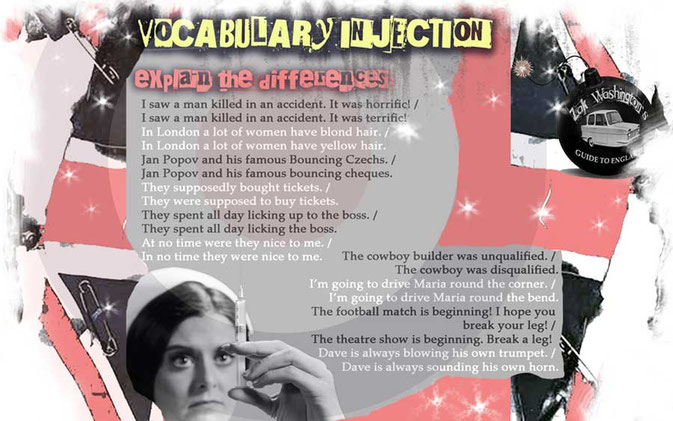
14.7. Vocabulary. Explain the differences in the following (C2 level - Difficult!)
I saw a man killed in an accident. It was horrific! / I saw a man killed in an accident. It was terrific!
In London a lot of women have blond hair. / In London a lot of women have yellow hair.
Jan Popov and his famous Bouncing Czechs. / Jan Popov and his famous bouncing cheques.
They supposedly bought tickets. / They were supposed to buy tickets.
They spent all day licking up to the boss. / They spent all day licking the boss.
At no time were they nice to me. / In no time they were nice to me.
The cowboy builder was unqualified. / The cowboy was disqualified.
I’m going to drive Maria round the corner. / I’m going to drive Maria round the bend.
The football match is beginning! I hope you break your leg! / The theatre show is beginning. Break a leg!
Dave is always blowing his own trumpet. / Dave is always sounding his own horn.

(TEXT VERSION)
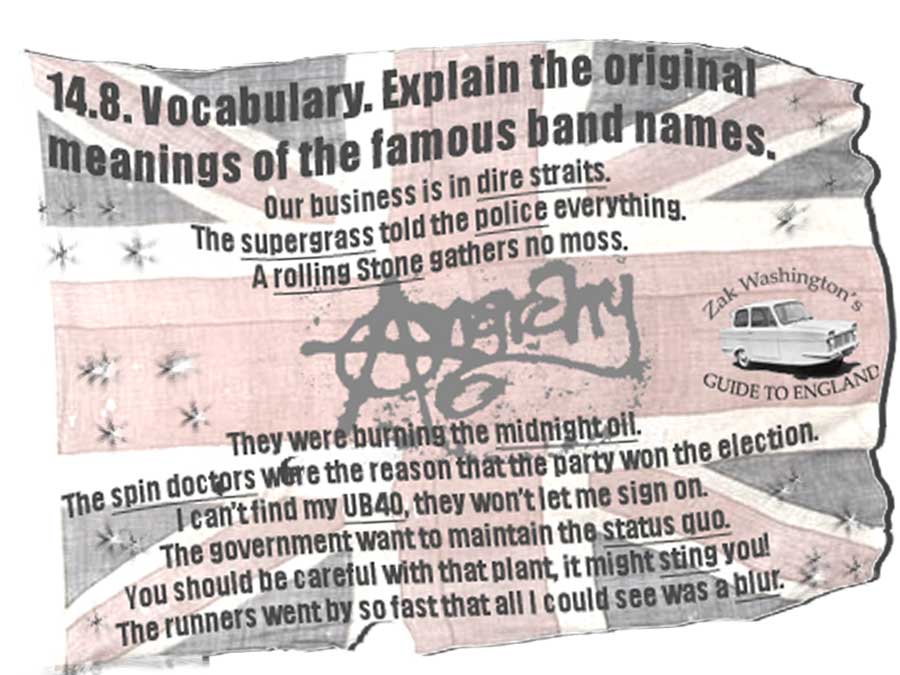
14.8. Vocabulary.
Explain the original meanings of the famous band names.
Our business is in dire straits.
The supergrass told the police everything.
A rolling stone gathers no moss.
They were burning the midnight oil.
The spin doctors were the real reason that the party won the election.
I can’t find my UB40, they won’t let me sign on. (Historical one this!)
The government want to maintain the status quo and not bring about any drastic changes.
You should be careful with that plant, it might sting you!
The runners went by so fast that all I could see was a blur. The photos came out blurred too.

(At Speaker’s Corner)
MARIA: This is very interesting! There are lots of people talking about different things. That guy is talking about politics. That one, over there, is talking about corruption in the church.
GIOVANNI: There’s a man talking about how women are inferior. There’s a Marxist, over here...and an anarchist over there.
FRANCESCA: This is completely ridiculous! There are two people claiming that they are Jesus Christ! They can’t both be right!
14.9 EFL VOCABULARY HECKLER RETORTS

Here are some classic phrases for the use of either speakers or hecklers. Match the beginning of these phrases with the correct endings.
1. I refuse to have a battle of wits…
2. I’ll buy you a drink...
3. Why don’t you follow the example of your head….
4. Here we have one guy....
5. Why don’t you have a shave?...
6. I’ve seen better faces on a clock...
7. Look! It’s my old school master...
8. (to a man) Good to see you again!..
9. Save your breath...
10.You’ve got just the kind of looks for television...
a...if you drink it in France.
b...you’ll need it to blow up your date later.
c...your face looks like my armpit.
d...two more legs and you could star in a western.
e...even when a cuckoo came out of it.
f...how’s it going Master Bater?
g...who will never get cancer of the brain.
h…and come to a point.
i...back in men’s clothing.
j…with someone who is unarmed.
Now explain why these comments are funny/clever/rude etc. Who is talking? The speaker or the heckler?


(TEXT VERSION)
HOMEWORK!
In the next class you are going to give a public speech.
It will be better for you to prepare something in advance, because you may have problems with hecklers!
You need to prepare a subject that you can talk, and answer questions about.
Read the text below, and you will find some suggestions for themes.
Or, make up your own. There are some arguments written for you, but it will be better if you look on the Internet, or in the library for information about these subjects.
You should memorise as much as you can in advance, as you won’t be able to use notes.
You should also memorise some of heckler retorts too.
Everybody in the class will talk, so don’t even consider thinking up an excuse.
Your teacher and classmates are particularly good hecklers, and will victimise anybody who doesn’t do the proper [1] preparation.
[1] Proper (adj.) (noun) a very common adjective, that is underused by students. Most speakers of romance languages -like French and Spanish- use correct, appropriate, adequate, or sometimes real or right, because they have cognates in their own languages that are very similar.
There are certain times when proper is the .....proper word to use because the meaning is correct, but also the most appropriate:
Do you think that these would be the proper shoes to wear on holiday? (The appropriate shoes.)
Stop playing with your food, and eat it properly! (Eat it in the correct way.)
That’s not a proper fish and chip shop. The owners aren’t British. (A real or genuine chip shop.)
SPEAKER'S CORNER
CLASSROOM ACTIVITY
You are going to Speaker’s Corner.
Now it’s your turn to speak in public!
You will divide yourselves into groups of four.
Each group will need a ‘soapbox[1]’. You can use a chair for this. You will take it in turns to speak.
You are going to speak about a subject of your choice.
The first speakers will get up on their chairs (the soapboxes).
The other students will be the public[2] and hecklers.
You must listen carefully to what the speaker is talking about, and try and make intelligent jokes and comments about what he/she says.
Just like people do at Speaker’s Corner.
You can only insult the speaker, if it is a very clever insult, like one of the examples that we have studied above.
Don’t forget that the speaker can make you look very foolish in front of the whole group. Be careful!
Larger classes can have several speakers at the same time. Hecklers can move from one speaker to another, if they wish.
Everybody in the class will speak.
You will have five minutes sat together, in which to prepare your speech.
The theme can be one of the following, or alternatively, you can think of your own subject, preferably something that you know very well.
GLOSSARY AND USAGE
[1] Soapbox (noun) this refers to any type of box or platform, that people stand on to speak in public.
These were traditionally boxes for storing soap in, but the original meaning is now lost.
To be on a soapbox is an idiom that means to make a speech in public, usually with the purpose of educating or informing people, and is especially common to talk about politics.
It implies a passionate discourse, and often is used to describe someone who talks in a self-centred way.
[2] Public (noun) (adj.) this is a very confusing area of English, as we use different words to talk about groups of people in public places.
The public is the most generalised way of referring to a large number of unknown people.
The general public meaning the anonymous mass of people of the whole country; the general public in Britain love a good scandal. But the word cannot be used for every situation.
Sports events are attended by spectators; concerts, shows, conferences, cinema, theatre, television etc, by an audience. If you were attending a church service, you would be a part of the congregation.
Another noun which can be used to talk about a large number of people together is a crowd, this is a little more difficult to define, but the general sense is of a large mass of less controlled people;
A crowd of demonstrators gathered in the street.
Football supporters and rock fans, are often referred to as crowds, as noise and rowdiness is implied, but you would never use it to talk about classical music fans at the opera.
IDEAS FOR SPEECHES.
The importance of an international language. Esperanto, English, etc.
The time has finally come to unify ourselves linguistically. Your arguments; In a lot of countries English is spoken very well.
Places like Scandinavia and Holland have high levels of education, obligatory original version films and a general acceptance of English as the lingua franca.
On the other hand, in some Europeans countries like Spain and Italy, people speak English like Tarzan, can’t pronounce Jane, and are uglier than Cheetah.
This is the linguistic third world, and these people need education.
And you’re going to give it to them.
This is your chance to talk about all those theories that you have about creating an international language.
What do you mean you don’t have any?
Make something up then.
Euro-scepticism.
Pretend [1] to be British!
You don’t want to be European.
Why not? Europeans stand on the wrong side of the escalator in Leicester Square tube station.
They call it a 'metro'.
They drive like kamikazes, have the worst traffic accidents, ignore the traffic lights, park anywhere, drive on the pavement, and then tell us that we drive on the wrong side of the road!
Europeans eat snails[2], smell of garlic, and iron their socks. Europeans live with their parents when they are thirty five years old, wear bright yellow jumpers, and listen to Julio Iglesias' records.
This madness must be stopped immediately.
Men are superior to women. / Women are superior to men.
(Guaranteed to get a reaction!)
This is usually what speakers talk about when they want to stimulate an argument or a discussion.
You can make lots of generalisations about gender, and jokes about people in the audience.
The speech should be good humoured, as some of the public could get very upset.
Arguments for men;
Women are interested in feminism until it’s time to do one of those dirty jobs in the house, like repairing the toilet.
Then they suddenly forget all about female liberation.
How many times have you seen a woman digging the garden?
Exactly. Never.
For women; You’ve spent your entire life criticising men.
Don’t tell us that now, when it’s most important, you can’t think of anything to say.
You have a message. End male domination and oppression. Sisters are doing it for themselves! Etc. Etc.
Globalization with benefits for all.
You can attack the capitalist corporate world, defend the rights of the poor and oppressed, and really say something that matters.
What you say today could change the way people think forever. Here are some arguments;
Some of the bigger companies in the world are now more important and influential than governments.
Democracy is disappearing as a handful of corporate leaders make all our decisions for us. Some companies have a budget[3] bigger than the GDP (Gross Domestic Product) of some nations. Of the top economies in the world, fifty-one percent are companies and forty-nine percent are countries.
These companies are often guilty of unfair labour practices –slave labour, exploitation, terrible work conditions etc.
They are also guilty of horrendous environmental abuses and mismanagement of natural resources.
Neo-liberal institutions such as the World Trade Organisation (WTO), the World Bank (WB), and the International Monetary Fund (IMF) dominate global economics and trade, and practice an extreme form of capitalism, channelling the flow of wealth from Asia, Latin America, Africa and the Middle East into the pockets of the already super-rich.
No-one else benefits. Put the interests of the majority of the planet first.
You are Jesus Christ.
(Very provocative this one. Don’t worry about upsetting people. This is a country with the right to free speech.)
There are always half a dozen mad people talking at Speaker’s Corner.
Why not add one more to the number?
Act like you are completely crazy.
Tell the audience that you have come to save the world.
Talk rubbish. Just make sure that you are entertaining, or the audience will crucify you.
Why America is ruining the world, and why we should all be opposed to it. (This is an easy one, but be careful, you might find some American hecklers in the audience.)
Why do the Yanks speak out of the side of their mouth, with a chewing gum in it?
Why are there over a million people in prison in ‘the land of the free’?
Why do Americans think that they are the world’s police?
Why do they violate human rights, while supposedly being the moral representative of us all.
Why do they wear shorts in public places when their legs are that bad?
Boycott American products, and ban those shorts now!
The environment.
A few years ago we were all very concerned about the future.
What happened? We are continuing to destroy the earth at an alarming speed.
Pollution is getting worse.
We still don’t recycle enough.
The world is still warming up.
We are still cutting down the rainforests at the same speed as before.
When will we learn?
Stop the persecution of the Arab world.
A very serious speech about a very serious subject, which is often spoken about at Speaker’s Corner. You are from the Middle East and are fed up at the constant media depiction of Arabs as terrorists, fundamentalists, and the enemies of the West.
The West has been far guiltier of international terrorism than the Middle East.
How can these countries, with their immoral greed and excesses, point the accusing finger at us?
Talk about the bombing of Iraq, Libya, etc.
Talk about the way Arabs are shown in films as terrorists.
Communism.
There are always a couple of good communist speakers here.
Marx, Lenin and Engels have all spoken at Speaker’s Corner.
Follow their fine tradition.
This can be your chance to be the voice of the masses against the capitalist oppressors.
Oppose the selfish struggle for money and personal gains.
Get out that red flag. Power to the people!
You will have a time limit of 10 MINUTES to speak.
If people distract you, try and make them look stupid.
To do this you can use the heckler retorts above, or some of the phrases from below.
(to return to the speech)
…as I was saying before I was so rudely interrupted.
…to return to my original point.
…anyway. What was I saying?
(to tell someone to go away)
You! Off my planet!
If I throw a stick, will you leave!
(to deal with hecklers)
Look, I’ve got ten minutes up here to make a fool of myself, you’ve got the rest of your life. So shut up!
I don’t know what your problem is, but I bet it’s hard to pronounce.
Any connection between your reality and mine, is purely coincidental.
I see that you have set aside the time to humiliate[4] yourself in public.
(to a male heckler)
Not all men are annoying….some are dead.
I’m trying to imagine you with a personality.
I like to make my speech the way that you have sex…… alone!
(to a female heckler)
Hey don’t interrupt me! This is my job. I don’t come to the place where you work, and jump on the bed!
14.10. Explain these phrases. How would you describe the different type of humour used in each? Do you know any similar ones that can be translated from your own language?

[1] To pretend (verb) one of the more common ‘false friends’ in Europe.
The real meaning is to act or to behave as if you are doing something, but not really do it:
When I saw my ex-girlfriend in the street, I pretended to be having fun with my new girlfriend. (In other words, I made it look like I was having fun, although the reality was different.)
So pretence (noun) means falseness. What it doesn’t mean is to try or to attempt, as is commonly believed.
[2] Snail (noun) the little animal that lives in the garden who walks very slowly and carries his house on his back.
[3] Budget (noun) an amount of money that is available for a project.
[4] To humiliate to embarrass, to shame, to make someone look very foolish.

(Still at Speaker’s Corner)
ZAK WASHINGTON:A very good afternoon to you students! It has been very interesting here at Speaker's Corner, but we need to get over to the airport.
AJMET: How is Ali?
GIOVANNI: He's not feeling very well. He is over there (pointing across the park) with Rosy and Maria. They have just given him his last alcoholic drink. He still thinks that he is suffering from jet lag. He doesn't realise that he's been drunk for the last few days.
FRANCESCA: I don't like him very much, I'm glad that he's going home.
AJMET: I'm going to miss him a lot. He's a great guy.
ZAK WASHINGTON: I agree with you too. He's been a very good sport[1]. Ali!!! Come over here. You've got to go home.
ALI: (drunk and singing a traditional song from his own country, that loses something in translation.)
¯More beautiful than a dozen camels is my Miss.
Her and eight others are the ones that I kiss,
I love her on Monday and Friday after tea,
With so many wives, I’m not often free!
She’s the love of my life, but it’s such a shame,
With so many wives, I can’t
remember her name.... (hic)! ¯
The students make your their way to Heathrow airport. The ticket inspector helps them get there without paying. Everybody is a little sad to see Ali go. The student's get on the Piccadilly line train to the airport. When they arrive they say goodbye to Ali.)
ZAK WASHINGTON'S ENGLISH ADVENTURE

AUDIO
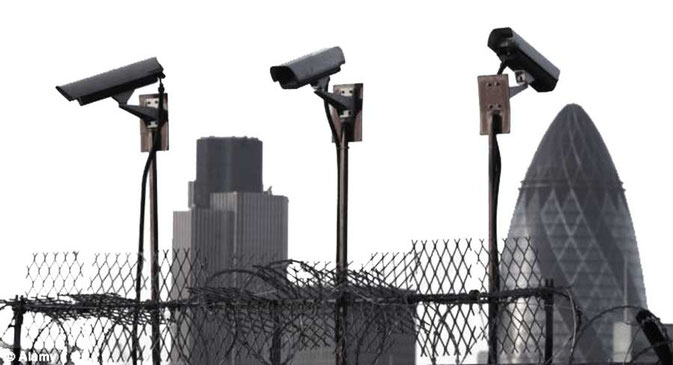
ZAK WASHINGTON: A very good afternoon to you students. Here we are in Heathrow! One of the biggest, busiest, most efficient airports in the world. Well Giovanni, now is the chance to learn a little bit of aviation vocabulary. Look around tell us what you see!
GIOVANNI: In front of us there is the departure desk, over there there is a baggage reclaim belt[1]. We can see a board above our heads that says the arrivals and the departures. There is a departure for the People’s Republic of Zangonia.
ZAK WASHINGTON: Well Mr. Ali Fred. I’m afraid that it’s just about time for us to say goodbye to you. We hope you have had a wonderful adventure with us here in Great Britain. Do come again and send our regards to all your friends back in Zangonia. And here’s a present of some traditional English refreshment for your journey.
ZAK WASHINGTON: What else can you see Giovanni?
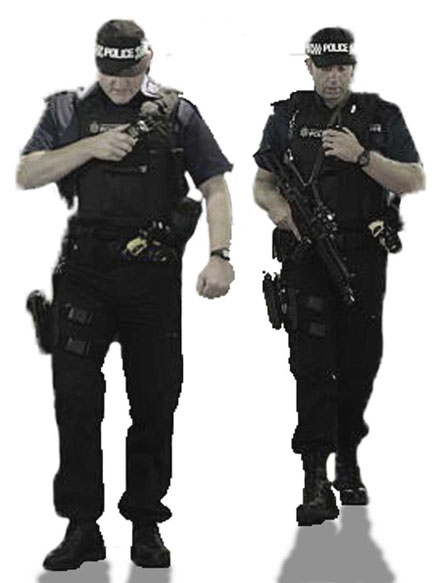
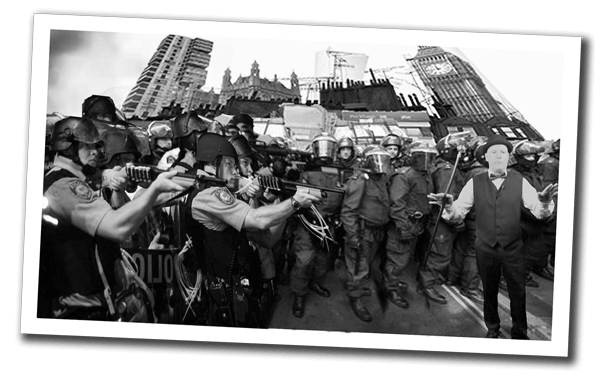
GIOVANNI: Well behind us there is… 150 soldiers, policemen, security guards, the FBI, the KGB, and the London Transport Authorities.
FIELD MARSHALL COLIN HUNTINGTON: Nobody move. You are under arrest for ….
GIOVANNI: They are armed with machine guns, automatic rifles, revolvers, bayonets, bazookas, rubber bullets, truncheons, wooden clubs, spears, stun guns, tranquilliser guns, motorbike chains, daggers, switchblades, tear gas canisters…
FIELD MARSHALL COLIN HUNTINGTON: ….hooliganism, assault, blackmail, high treason, kidnap, hijack, fraud, perverting the course of justice, unlawful entry, criminal damage, disturbing the peace, breaking and entering, illegal gaming, corruption of minors, indecent exposure, and fare evasion on a London Underground train.
[1] Conveyor belt (noun) the moving surface that transports your suitcases to the aeroplane. A similar device is found in factories on a manufacturing or assembly line.

CLASSROOM ACTIVITY
Students get into pairs and number the above weapons (in bold) that the authorities were carrying, according to weight. Number one is the lightest. Some may have a similar weight. Discuss as much as you can.
|
1 |
11 |
|
2 |
12 |
|
3 |
13 |
|
4 |
14 |
|
5 |
15 |
|
6 |
16 |
|
7 |
17 |
|
8 |
18 |
|
9 |
19 |
|
10 |
20 |
Then, as a group, discuss what each of the above objects is. No hands! This is not a mime class. Explain what each one looks like and what it does.


Students get together in pairs again. This time with a different partner. Look at the list of charges above, and put them into order of seriousness. Number one is the crime that will get you the most years in prison. Consider the crimes committed by the ‘Washington Terrorist Organisation’ that have been perpetrated throughout this book.
|
1 |
9 |
|
2 |
10 |
|
3 |
11 |
|
4 |
12 |
|
5 |
13 |
|
6 |
14 |
|
7 |
15 |
|
8 |
16 |
Then, as a group, discuss what each of the above crimes mean, how serious it is and how long you'd go to prison for.